

Montessori Toys vs Traditional Educational Toys: What’s the Difference?
Mar
Introduction
Parents today have more toy options than ever before. However, more choice often means more confusion. Many mothers buy a toy labeled educational, yet their child ignores it after two days. Meanwhile, some simple wooden toys keep children focused for 30 minutes or more. So what is happening? The answer often lies in understanding the difference between Montessori toys and traditional educational toys.
In this guide, you’ll learn:
- How the two types of toys actually work
- Why children engage differently with them
- Which one is right for your child
- How to avoid wasting money on the wrong toy
What Are Montessori Toys?
Montessori toys are based on a simple principle:
Children learn best when they discover things themselves.
Instead of teaching directly, these toys allow the child to experiment, repeat, and self-correct.
Key characteristics of Montessori toys
- Made from natural materials (often wood)
- Focus on one skill at a time
- No flashing lights or sounds
- Encourage independent play
- Allow self-correction
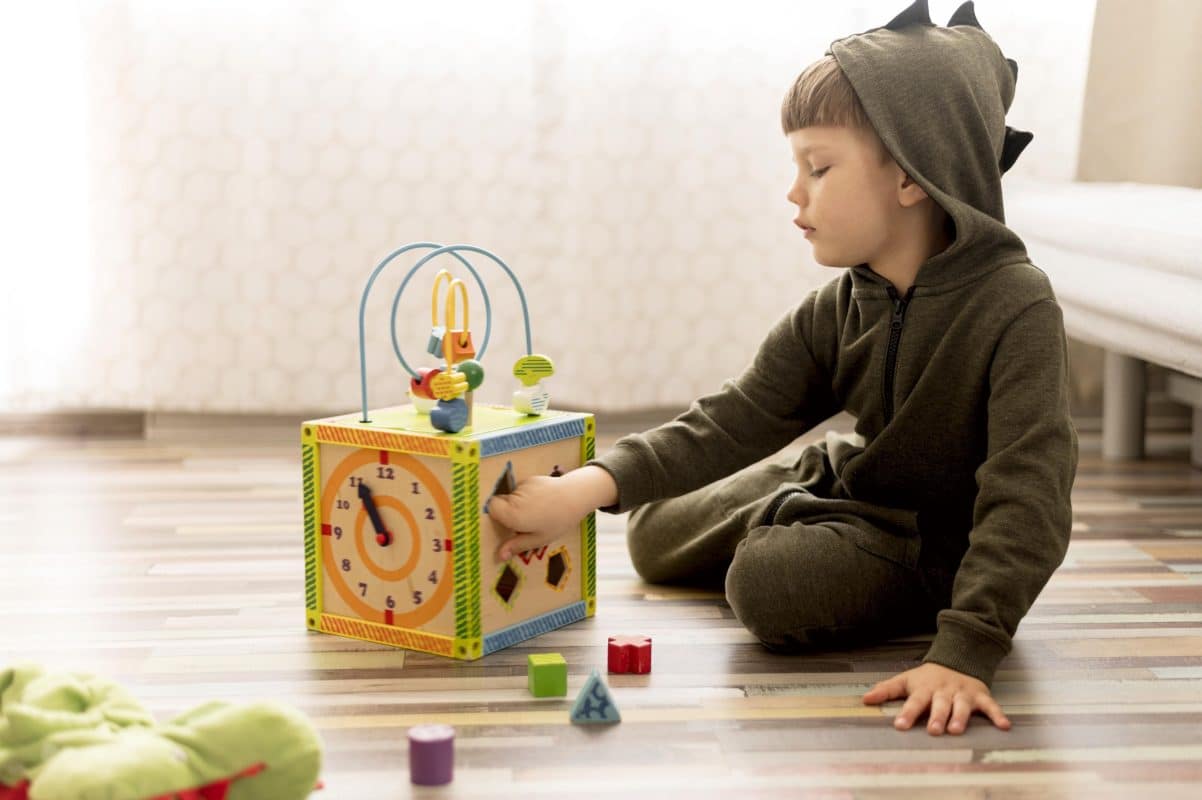
A shape sorter is a good example.
The child tries → fails → adjusts → succeeds.
The toy does not reward.
The child’s brain rewards itself.
What Are Traditional Educational Toys?
Traditional educational toys usually try to teach children information.
They often include:
- Numbers
- Letters
- Songs
- Lights
- Buttons
These toys stimulate attention quickly. But the learning is often passive.
The toy performs.
The child watches.
Typical features
- Bright colors
- Sounds and music
- Multiple functions
- Quick entertainment
- Short attention span usage
Parents often think more stimulation equals more learning.
But neuroscience shows the opposite can happen.
The Core Difference: Learning vs Performing
| Montessori Toys | Traditional Educational Toys |
|---|---|
| Child active | Toy active |
| Focused attention | Distracted attention |
| Problem solving | Button pressing |
| Deep learning | Surface learning |
| Long engagement | Short engagement |
A child playing with stacking rings must think about size order.
A child pressing a music button only repeats a motor action.
This difference directly affects brain development.
Why Children Engage Longer With Montessori Toys
Many parents notice something surprising:
A simple toy holds attention longer than a complex toy. Simple hands-on tools like Montessori Eggs Toy encourage active learning instead of passive entertainment.
This happens because of cognitive load.
Overstimulating toys
Lights + music + movement overload the brain.
The brain switches to passive mode.
Focused toys
One task activates concentration networks.
The child enters what psychologists call:
deep play state
Skill Development Comparison
1. Problem-Solving Skills
Montessori toys force thinking:
- Trial and error
- Pattern recognition
- Cause and effect
Traditional toys often provide the answer immediately.
2. Attention Span
Children develop attention like a muscle.
Montessori → strengthens it
Electronic toys → interrupt it
This is why many children lose interest in toys quickly.
3. Confidence and Independence
When a child solves a puzzle alone:
The brain releases dopamine linked to mastery.
Not entertainment.
Achievement.
That creates intrinsic motivation.
When Should You Choose Montessori Toys?
Montessori toys are especially beneficial if your child:
- Gets bored quickly
- Depends on adults during play
- Moves quickly between toys
- Gets frustrated easily
- Struggles with concentration
They help reset the play pattern from passive to active.
Age-Based Recommendations
Toddlers (1–3 years)
Best focus: motor control & cause-effect
Examples:
- Object permanence boxes
- Shape sorters
- Stacking toys
Preschoolers (3–5 years)
Best focus: logic & sequencing
Examples:
- Matching activities
- Simple puzzles
- Practical life tools
Early School Age (5–7 years)
Best focus: reasoning & independence
Examples:
- Sequencing games
- Early math manipulatives
- Pattern challenges
Common Mistakes Parents Make
Mistake 1: Choosing entertainment over engagement
If a toy performs more than the child → learning drops.
Mistake 2: Too many features
More buttons = less thinking
Mistake 3: Wrong difficulty level
Too easy → boredom
Too hard → frustration
Mistake 4: Buying by age label only
Development level matters more than age.
Can You Mix Both Types?
Yes — and you should.
The best approach:
80% developmental toys
20% entertainment toys
Children need fun.
But they also need brain growth.
Balance prevents burnout and boredom.
How to Transition Your Child to Montessori-Style Play
- Remove noisy toys temporarily
- Introduce 2–3 focused toys only
- Do not demonstrate immediately
- Allow struggle
- Let repetition happen
Within a week, most children:
- Play longer
- Ask for less screen time
- Show more independence
Final Thoughts
The goal of a toy is not to occupy your child. It is to build the brain. Traditional educational toys deliver information. Montessori toys develop thinking. Both have value — but not equal impact. For hands-on examples, you can explore Montessori activities for fine motor skills that help children build real-life coordination and independence. When you choose toys that require effort, you give your child something far more powerful than knowledge:
You give them the ability to learn.
FAQ
Are Montessori toys better than educational toys?
Montessori toys are better for developing problem-solving and focus, while traditional educational toys are better for entertainment and exposure to concepts.
At what age should a child start using Montessori toys?
Children can start as early as 12 months with simple cause-and-effect toys.
Why does my child ignore learning toys?
Many toys overstimulate rather than engage, which reduces attention span.
Do Montessori toys increase independent play?
Yes. Because they allow self-correction and mastery, children play longer without adult help.